



U-value and g-value: what your quote numbers mean

U-value and g-value: what your quote numbers mean
U-value is how fast heat leaves through the window. G-value is how much of the sun’s heat comes in through the glass. They are not two names for the same thing, and a north wall and a south wall often want different numbers.
What is a U-value, in plain words?
A U-value is how quickly heat passes through something. On a window, a lower number means less heat escaping. It is a rate, not a score out of ten.
The unit is W/m²K. You never need to do that sum. You only need to know that 1.2 loses less heat than 1.4, and that the gap between two quotes means nothing unless both numbers were measured the same way.
There is a floor. In England, a replacement window has to achieve 1.4 W/m²K, or a Window Energy Rating of Band B as a minimum — a letter band, much like the label on a fridge. That has been the standard since June 2022, and timber windows lost their temporary higher allowance in June 2023, so nobody gets a softer figure now. Wales, Scotland and Northern Ireland are covered by their own documents, so check the one for where you live rather than a figure you read for England.
That floor is a legal minimum, not a target you have to beat. Going well below it is a choice about comfort and running costs, and it is a reasonable one — but nobody is obliged to make it. The 2026 edition of the same English document is already published and keeps this figure exactly where it is, taking effect in March 2027. If anyone tells you to buy now because the rules are about to change, that is not what the rules say.
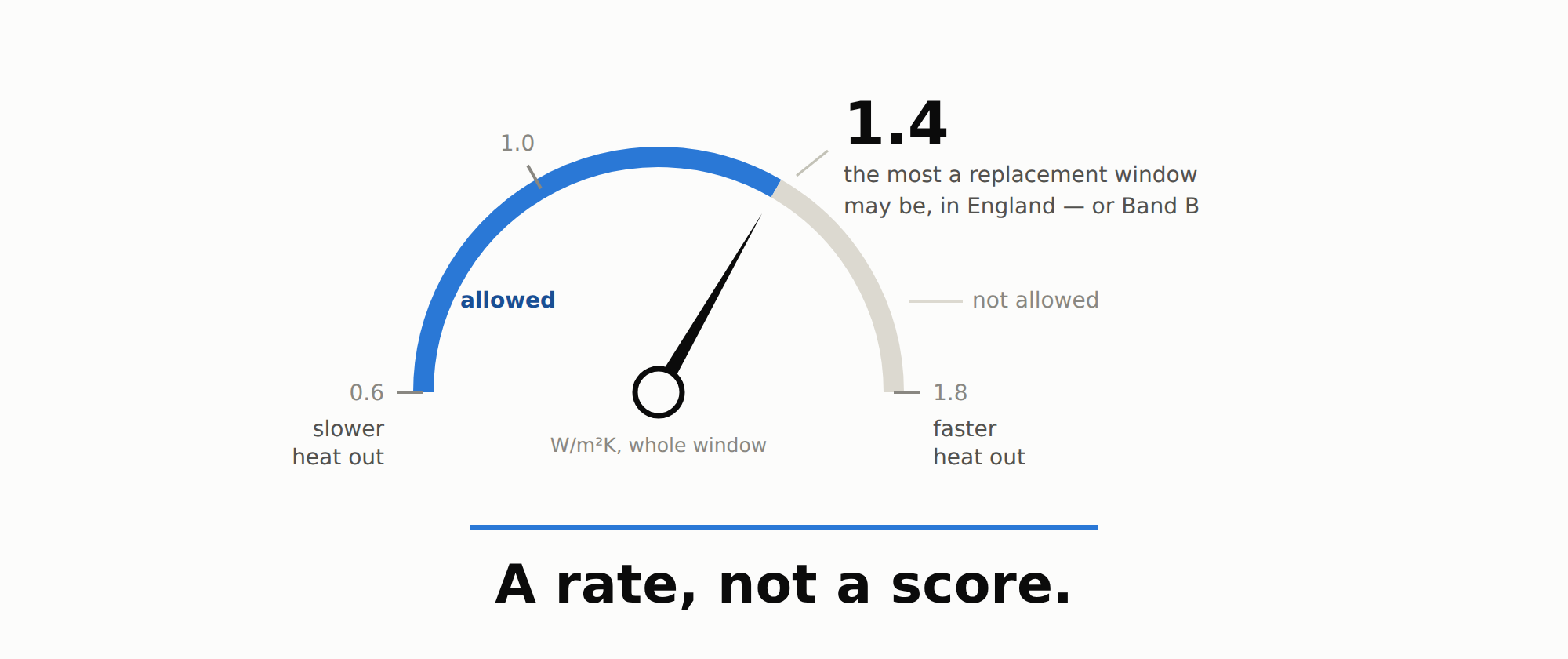
Figure A
Is the number on my quote the glass or the whole window?
Usually that figure is Ug — the U-value of the glazing. It ignores the frame and the spacer that holds the panes apart at the edge. The number that describes the window you will live with is Uw — the U-value of the whole window.
The spacer is the strip running around the perimeter of a sealed unit, keeping the panes apart. Glass, frame and spacer all lose heat at different rates, and the middle of the pane is the best-performing part of the whole assembly. So the whole-window figure is most often higher — worse — than the glass figure for the same window. Because frames and edges lose more heat than the middle of a modern glass unit. Not because anyone is cutting corners.
The whole window is also what the building regulations measure. In England the limit is set for the window as a unit — frame, glass and spacer together, worked out for a standard-sized window using the Building Research Establishment’s published method — not for the middle of the pane.
If one quote shows 1.2 and another shows 1.4 for what looks like the same window, the first question is not “who is cheaper”. It is “are we looking at the glass or the window?” That is the common mistake — a glass figure and a whole-window figure set side by side, and the supplier who quoted the glass looks like they are offering more.
The difference between double and triple glazing sits mostly in that glass figure. The frame still has to carry the unit.
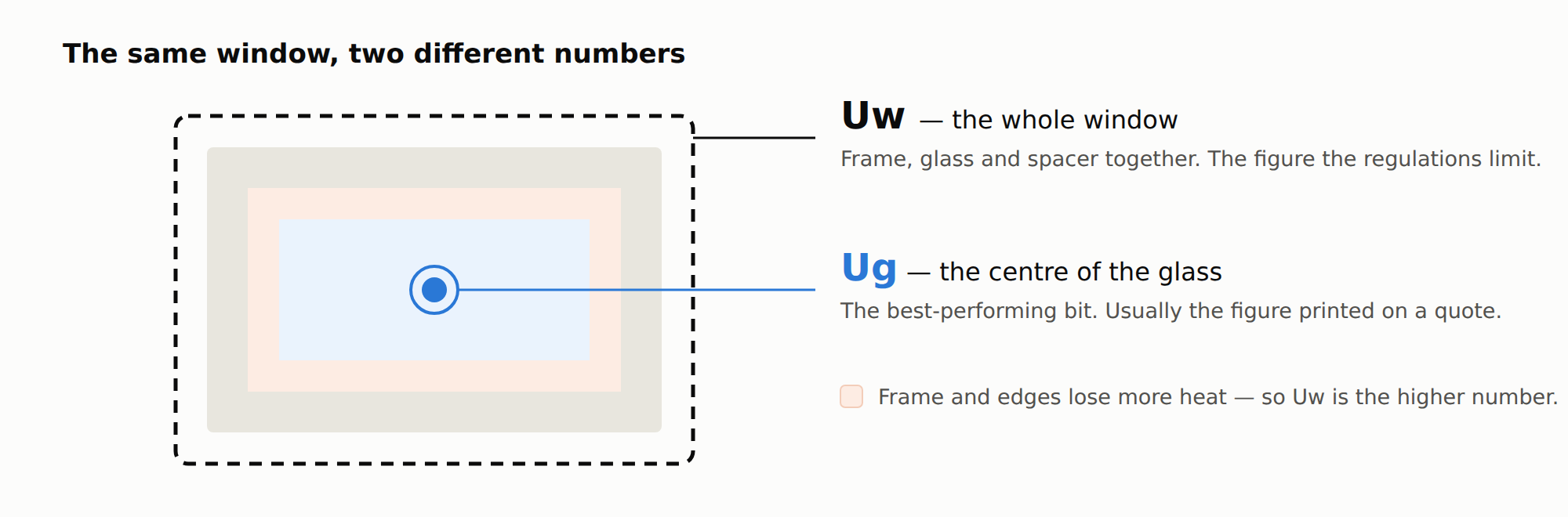
Figure B
What is a g-value?
A g-value is the share of the sun’s heat that gets through the glass. It runs from 0 to 1. A g-value of 0.70 means about seven-tenths of that solar heat arrives in the room; 0.45 means less than half.
A higher g-value is useful on a cold elevation that never sees much sun: free heat, less work for the boiler. The same high g-value on a large south or west window is how a sitting room becomes a greenhouse in June.
U-value and g-value can move in opposite directions. Better insulation — a lower U — does not automatically mean less sun. Chasing the lowest U on every opening is not a specification. It is a habit.
One thing worth knowing before anyone sells you on it: there is no minimum or maximum g-value your replacement windows have to meet. Approved Document O — the English overheating guidance, in force since 15 June 2022 — covers new residential buildings, not replacing windows in a house that is already there. On a replacement job the g-value is a comfort decision about your own rooms, not a compliance box. And in Wales, Scotland or Northern Ireland it is not your rulebook at all.
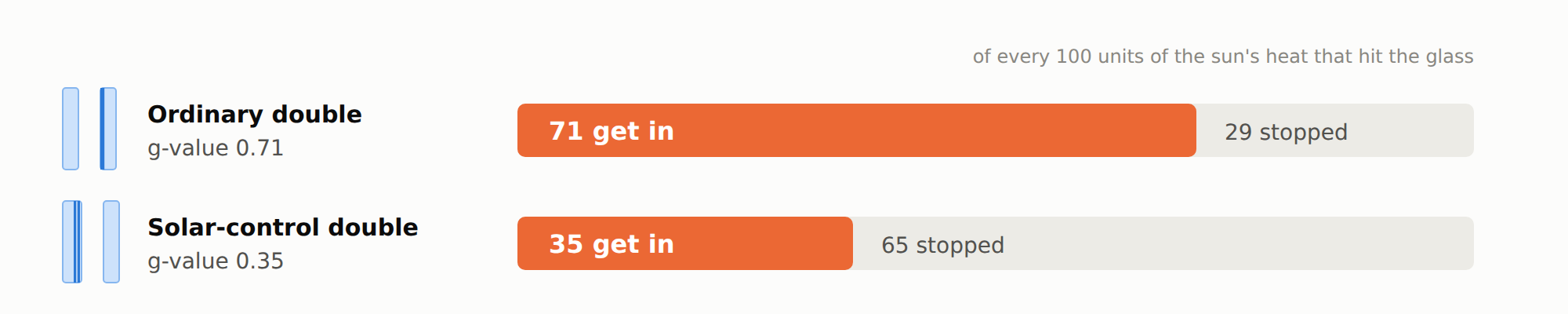
Figure C
Should north-facing and south-facing rooms have different glass?
Often yes. A north wall usually wants a lower U-value; a large south or west window often wants a lower g-value. Those are two different jobs, and they are not always the same glass unit.
A north wall loses heat and gains almost no sun, so the job there is to keep what heat you have. A south or west window already gains sun, and the job there is to let in the light while holding back more of the heat. Mixing specifications across one house is normal. Mixing them on one elevation needs a reason: a deep reveal, a balcony overhead, a tree that takes the sun.
Triple glazing is not automatically the right answer on the sunny side. An extra pane lowers heat loss; it does not, by itself, decide how much sun comes in. If overheating is the problem, ask for the g-value, not another pane.
Ask for that conversation. It is not a default on every quote. Raise it if a room already runs hot, or if a north room never warms up.
The figures below are calculated examples for the glass only — Ug and g of the unit, not the whole window, and not the number that will appear on every quote.
Read “4 / 16 argon / 4” as a 4 mm pane, a 16 mm gap filled with argon — a heavy, still gas that slows heat crossing the gap — then another 4 mm pane. “Low-e” is a coating of metal and metal-oxide layers, far too thin to see, that reflects heat back into the room. “Laminated” means two thinner sheets bonded together with a plastic interlayer, and a “twin-silver” coating carries two of those invisible silver layers instead of one.
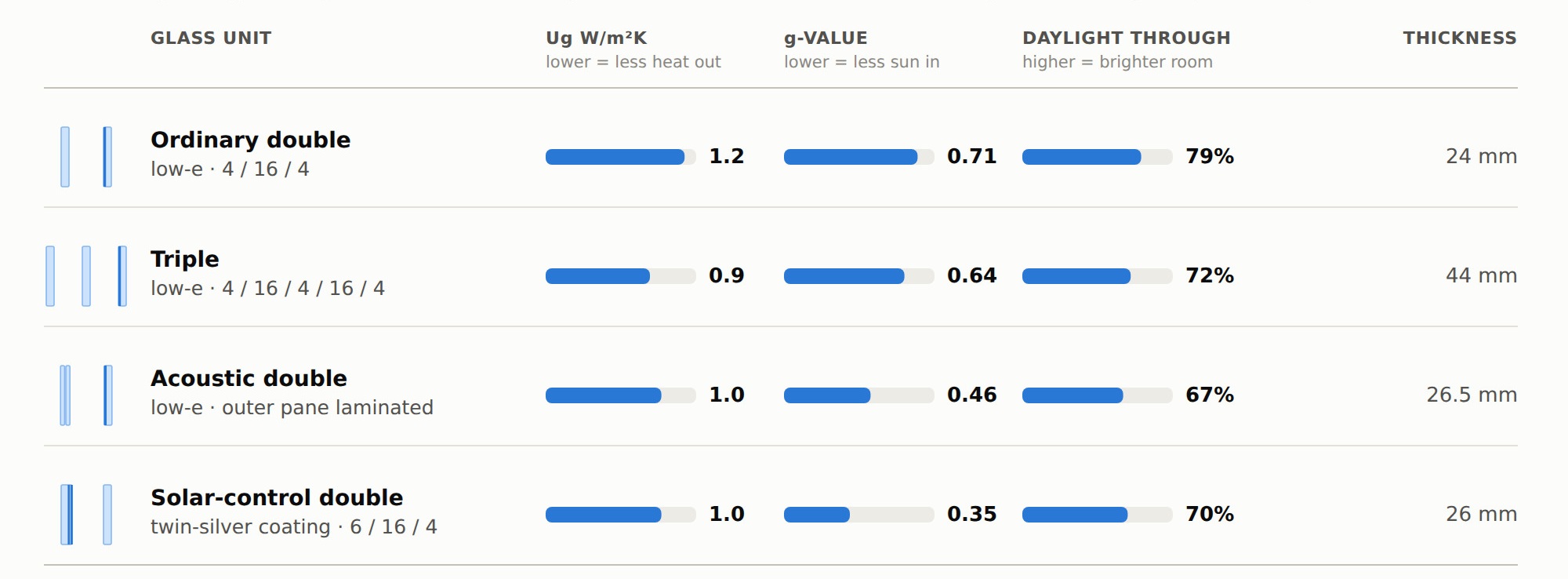
Figure D
Look at the last two. Identical Ug of 1.0, and they do completely different jobs. The acoustic double is not “worse” because it is not triple. On a sunny wall the unit with the lowest g may be the one that suits, and it does not have to be the thickest or the one with the most panes. On a north wall the triple may be right. What matters is that the quote says which elevation each unit is for.
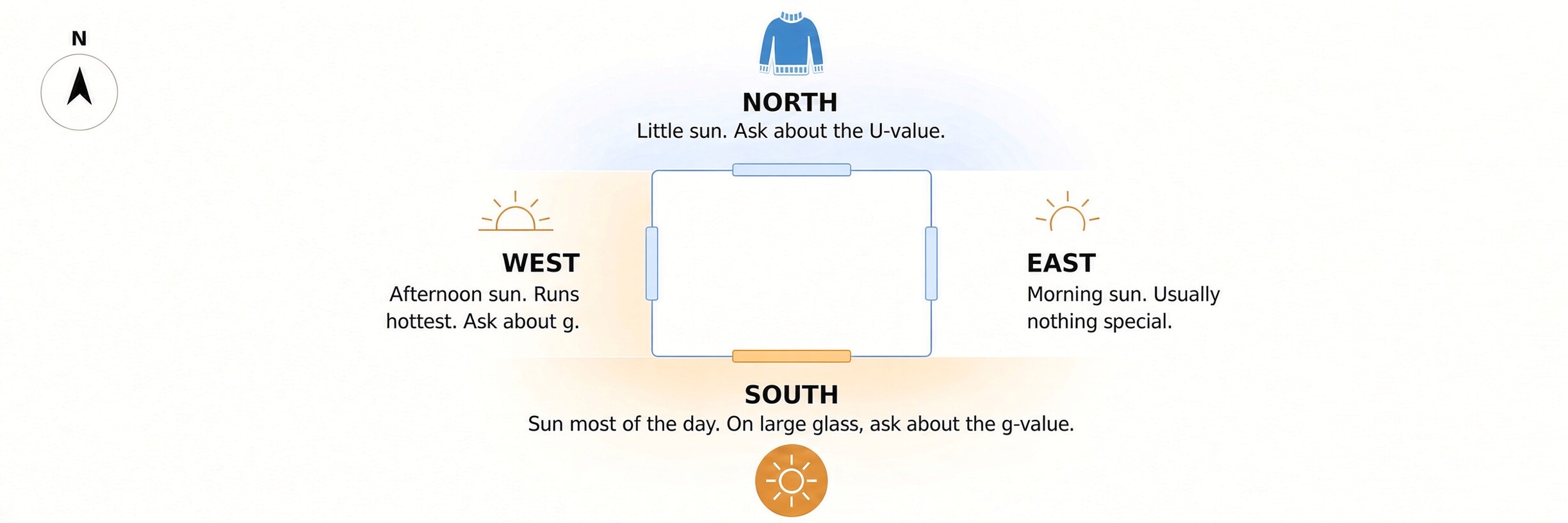
Figure E
What should I check when two quotes show different numbers?
Same opening, same frame name, different number. Two usual reasons, in the order worth settling them:
- One quote is showing Ug and the other is showing Uw. Settle this first — until you have, the second cannot be judged.
- Different glass — coating, gas, pane count or pane thickness.
Ask for all three of these, in writing, on both quotes:
- the whole-window U-value (Uw), not only the glass.
- the g-value.
- what changes if you swap the glass on the sunny side only.
If a supplier cannot separate those three, you are not comparing windows. You are comparing two printouts.
The numbers are only half of it. There is a method for putting two quotes on the same footing, line by line, before you look at either total.
Three questions to send to every supplier, including us.
They work with any company, and the answers are comparable however different the quotes look.
- Is the U-value on this quote the whole window (Uw) or the glass only (Ug)? Please give me the whole-window figure.
- What is the g-value of the glass you have specified?
- If I changed the glass on the south and west windows only, what would change — the U-value, the g-value, the light?
Bring the elevation — north, south, east, west — not just the room name.
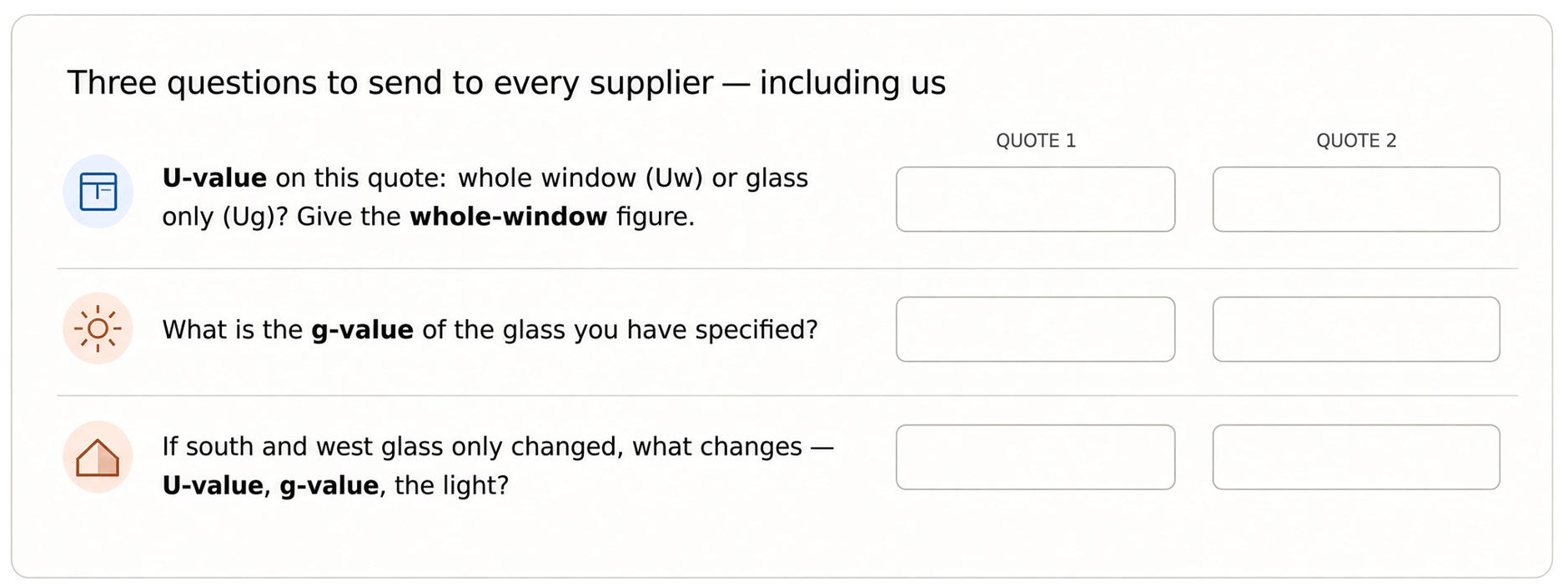
Figure F
Talk it through before you sign the quote.
Where these rules come from
The 1.4 W/m²K or Band B standard, and how a window U-value is worked out: Approved Document L, Conservation of fuel and power, Volume 1: Dwellings, 2021 edition incorporating 2023 amendments — for use in England, in force 15 June 2022. Table 4.2 and
paragraphs 4.1, 4.2 and 4.7–4.10. The temporary 1.6 / Band C allowance for timber windows ended on 14 June 2023.
The next edition: Approved Document L, 2026 edition (England), published 24 March 2026, in force 24 March 2027 — and 24 September 2027 for higher-risk building work. It keeps 1.4 / Band B for replacement windows.
Overheating: Approved Document O, 2021 edition — for use in England, in force 15 June 2022. Paragraph 0.3 limits it to new residential buildings.
Wales, Scotland and Northern Ireland have their own building regulations and their own documents.
Karol Szymkiewicz, Perfect Crystal Windows