



What is the difference between double and triple glazing?
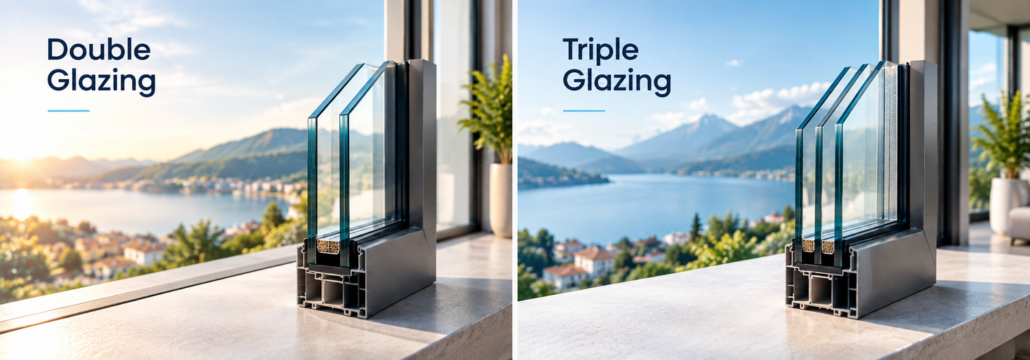
What is the difference between double and triple glazing?
Triple glazing adds a third pane and a second sealed gap. On a like-for-like comparison of two standard units, it cuts heat loss through the glass by about a quarter, adds roughly half again to the weight, and makes almost no difference to noise. On many replacement projects a well-specified double glazed unit is enough.
That last sentence is the one most articles leave out. Triple glazing is a real improvement in one specific respect and close to irrelevant in a couple of others, and there is one common situation where it is actively the wrong answer. This page gives you the actual figures so you can tell which applies to your house.
One definition first. A sealed unit is the piece of glass in a window: two or three panes bonded around a spacer bar, with a sealed gap between them filled with argon, and normally with a low-emissivity coating — microscopically thin layers of metal and metal oxide on one pane face that reflect heat back into the room. Double glazing has two panes and one gap. Triple has three panes and two gaps.
What actually changes when you add a third pane?
The glass gets warmer, thicker and heavier. Almost nothing else about the window changes.
The figures below are for two units built the same way, so the third pane is the only difference: 4 mm panes, 16 mm argon-filled gaps, the same warm-edge spacer — the strip that holds the panes apart around the edge — and the same coating.
| Double 4-16-4 | Triple 4-16-4-16-4 | |
| Panes / sealed gaps | 2 / 1 | 3 / 2 |
| Heat loss through the glass (Ug) | 1.2 W/m²K | 0.9 W/m²K |
| Sound reduction (Rw) | 31 dB | 32 dB |
| Weight | 20 kg/m² | 30 kg/m² |
| Thickness | 24 mm | 44 mm |
| Daylight through the glass | 79% | 72% |
| Free solar heat (g-value) | 0.71 | 0.64 |
Both units were calculated in the glass manufacturer’s own performance tool, using the standard coating specified on a standard unit rather than an upgrade.
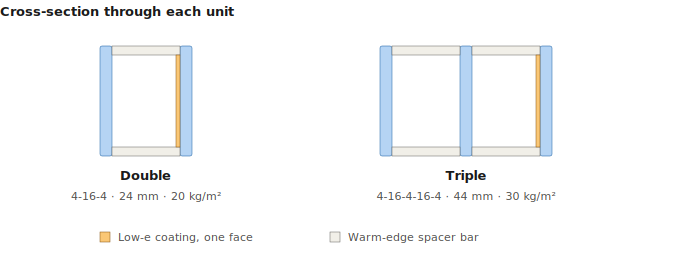
Figure A
Two of those rows are trade-offs rather than gains. Triple glazing lets in slightly less daylight and less free winter sun. The g-value is what measures that second one: the share of the sun’s heat that gets through the glass. Neither drop is dramatic, but if a room is already dim it is worth knowing before you order.
Will triple glazing make the house noticeably warmer?
It cuts heat loss through the glass by about a quarter — 1.2 down to 0.9 — and what you notice is a warmer glass surface rather than a different number on the thermostat.
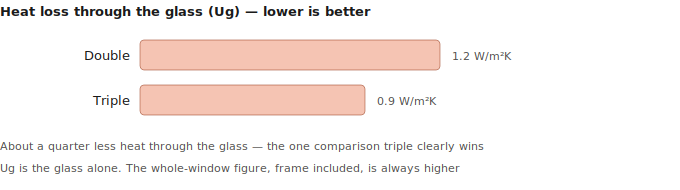
Figure B
That distinction matters. The cold you feel sitting by a window in January is mostly the glass pulling heat away from you and chilling the air that slides down it. A warmer inner pane changes that directly, which is why the difference shows up most in a room where you sit close to a lot of glass.
One thing to hold onto: Ug is the glass on its own. The number that describes your actual window, frame included, is the whole-window U-value, which includes the frame, so it is not the same number and normally the higher one. Better glass in a poor frame is still a poor window, so ask for the window figure rather than the glass figure.
Does triple glazing make a house quieter?
No — and this is where a lot of money gets spent on the wrong thing.
Standard double is rated 31 dB. Standard triple is 32 dB. One decibel apart, and the manufacturer states the accuracy of that calculation as plus or minus two decibels, so the two figures sit inside each other’s tolerance. Both figures are the glass manufacturer’s own calculations, on the standard coating a standard unit is quoted with.
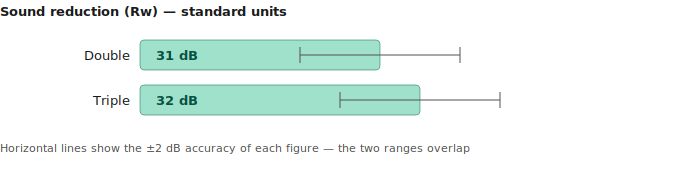
Figure C
What does change noise is the specification of the unit, not the pane count:
| Sound reduction (Rw) | |
| Standard double | 31 dB |
| Standard triple | 32 dB |
| Double with an acoustic laminated pane | 36 dB |
An acoustic unit replaces one pane with two thinner panes bonded around an acoustic interlayer. It is still double glazing.
It is 26.5 mm thick, so it fits frames a 44 mm triple unit will not, and it beats the triple on noise by four decibels.
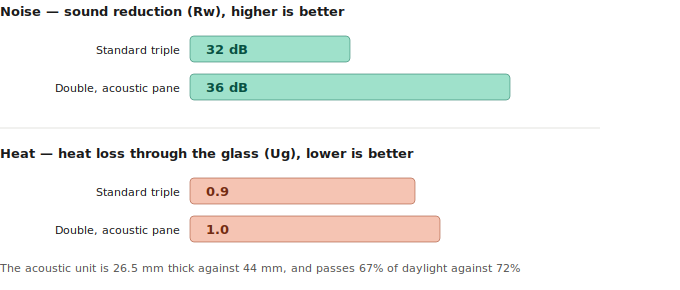
Figure D
There are trade-offs. That unit lets in less daylight, 67% against 79%, and considerably less free winter sun. Its Ug of 1.0 is better than the standard double’s 1.2, but that comes from a different coating on the glass rather than from the laminate. The laminate is what deals with noise; the coating is what deals with heat.
What a decibel figure actually means in a real room is a longer conversation than this page can hold, and we will cover it properly on its own page. For now the practical point: if noise is your reason, say the word “noise” at the quoting stage and ask for the Rw figure of the unit quoted. Ordering triple glazing and hoping is the expensive version of that conversation.
Will your frames take a triple unit?
Usually yes on weight. The limit that bites first is thickness — every frame system has a maximum glass thickness it will accept, and 44 mm is a lot to ask of a slim frame.
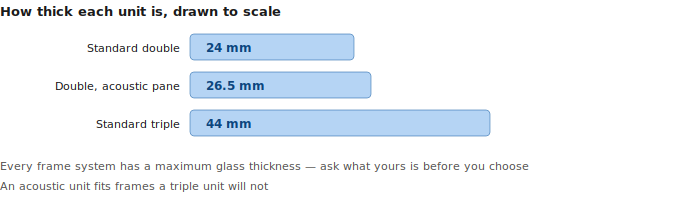
Figure E
Weight is normally the easier half, and where it shows up is in the hardware and in the profile itself. A heavier casement may need heavier-duty hinges or an extra one; a sliding door may need more or different rollers. Within the sizes set out in the system manual none of this is guesswork: systems are tested extensively before they go into production, and every manufacturer sets those limits with a margin, because nobody wants hardware trouble on installed windows. And once a window or door goes beyond those standard sizes, the profile steps up: a wider, thicker section is specified to carry it. Both the size of the opening and the weight of the glass drive that. Going above the recommended sizes is possible and it does happen — but at that point you are outside what the system was tested at, and the frame and hardware have to be specified for it deliberately rather than assumed.
Thickness is where the real decision sits, and it has a trap in it. If the frame will not take 44 mm, the way to fit a triple unit is a narrower gap between the panes. That unit is not the one in the table above, and the figures in that table do not describe it. Gap width is part of the specification, not a detail.
So ask two questions rather than one: what is the maximum glass thickness this frame accepts, and what is the Ug of the exact unit you have been quoted, with its gap widths and whether it is filled with argon or krypton? A slim triple you cannot compare like for like against a good full-gap double is not obviously worth paying more for.
When is double glazing enough?
Often. Specifically:
- Noise is the real reason. Then you want an acoustic unit, and a third pane is not it.
- The frame cannot take the full thickness. A slim-gap triple is not the same product as a full-gap one. Compare it against a good double before paying more for it.
- The room is short of daylight, or you want the winter sun. Triple takes a little off both.
- The opening is oversize. Once the size and the weight start driving the profile and the hardware, the upgrade is paying for itself twice.
- You are moving in a few years. The comfort difference is real but modest, and it is not something you see back in a sale.
Where triple earns its place: a room you actually sit in with a lot of glass on the cold side of the house, a frame that takes
the full unit without narrowing the gaps, and no particular noise problem.
Two quotes for what looks like the same window often differ for reasons that have nothing to do with the glass.
What to ask any supplier before you decide
Works with any company, including us:
- What is the U-value of the whole window, not just the glass?
- What is the maximum glass thickness this frame system accepts?
- How wide are the gaps in the unit quoted, and is the fill argon or krypton?
- What changes on the quote if I go back to double? Ask for it as a line, not as a conversation.
If the answer to the last one is vague, that is worth knowing before you sign anything.
We make windows in uPVC, timber and aluminium, and the answer above is the same one we give at a quote. If you are
comparing options for your property, send the basic requirements and we can explain the practical trade-offs before you
decide.
Karol Szymkiewicz, Perfect Crystal Windows