



How to compare window quotes properly

How to compare window quotes properly
Don’t compare the totals. Put every quote onto the same specification and the same site work, ask each supplier the same questions in writing, and only then look at the price.
By then, the cheaper quote is often missing something. Sometimes, though, it is simply cheaper. Then you don’t need to pay more.
Here is how it often goes wrong. Two quotes arrive in the same week. Both say “installation included”.
One also says how the outside will be finished: sealed around the frame with render, a cement-based finish, and silicone, or covered with trims. It also says the inside finishing is not included.
The other says nothing about finishing at all. The totals look close. But you can’t compare them yet, because you don’t know what the second one is pricing.
This guide gives you a method that works with any supplier, including us.
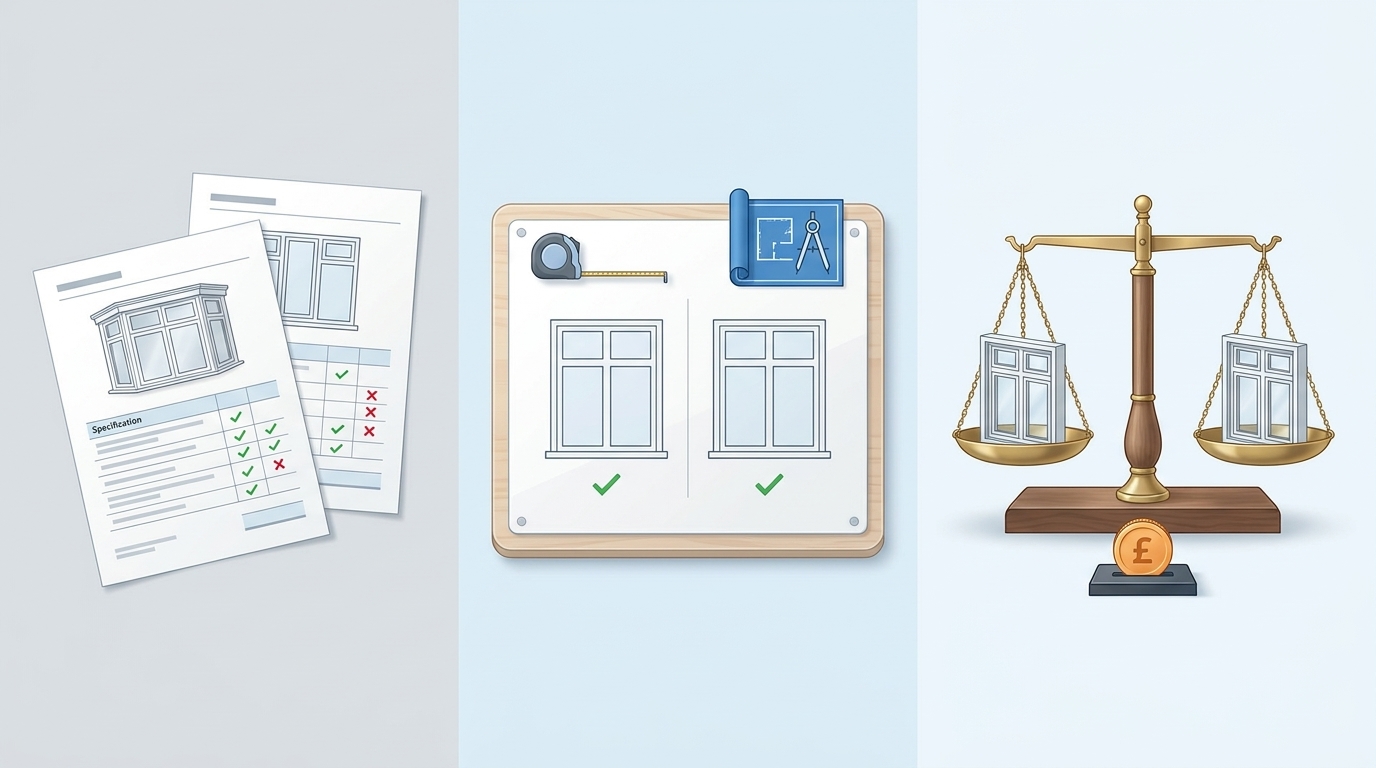
Figure A. Three checks, in this order: what each quote lists, whether the windows and sizes are the same, and only then the price.
What should a window quote tell you about the windows?
A window quote should name the product, not just the material, and give the sizes, the glass, the hardware and the finish. If a line is missing, ask for it in writing before you compare anything.
Look for these on every quote:
The product or range. “uPVC casement” (a plastic-framed window that opens on hinges) covers a great many different windows. The name of the system or range tells you which one you are getting.
A drawing with sizes. It should show the size of each window, which parts open, and which way. Check that the sizes match from quote to quote. There is more on why below.
The glass make-up. A line like 4/20/4 means two 4 mm panes with a 20 mm gap between them. The quote should also say whether the gap holds argon, a gas that slows heat loss, and whether the glass has a low-E coating. That is a very thin layer of metal and metal oxide on the glass that reflects heat back into the room.
Safety glass where it is needed: toughened or laminated glass in doors and low panes, which quotes often shorten to “Tuff”. In England, building regulations guidance sets out where it is required. Our guide to the different types of glass, including toughened safety glass, explains how they differ.
Ventilation. Trickle vents are small slots in the frame that let fresh air in while the window is shut. In England, if your old windows have trickle vents, the new ones should have them too, and no smaller. If they don’t, the guidance usually expects vents to be added, unless the room is ventilated another way.
Hardware and finish. Handles, locks, hinges, and the colour inside and out.
Performance figures you have to ask for
Performance figures are usually not on the quote, and when one does appear, it is often the glass-only figure. The U-value measures how much heat escapes through a window. The g-value is the share of the sun’s heat that comes through the glass. Sound reduction is measured in decibels (dB).
You normally get these figures when you ask for them, or when you talk them through with the person pricing the job. If one of them matters to you, ask every supplier for the same figure, in writing.
What does the price include, and what is left out?
Check the site work item by item, and treat anything not written on the quote as not included. A shorter list is not a better price.
Go through each of these:
Survey. Is a proper measure on site included?
Taking out the old windows, and taking them away. Check this window by window. One quote can include disposal for one window and leave it out for the next.
Making good outside. Finishing around the new frame, usually render and silicone, or trims. Check which method the quote gives, as well as whether it is included.
Making good inside. Plaster, trims and the window board, which is the shelf-like sill on the inside. These are often listed separately, and often not included.
Access. Scaffolding or lifting equipment for upper floors or heavy glass.
Parking. If your street needs a permit, who arranges it and who pays?
Building regulations. In England, the work has to meet building regulations either way. A company registered with a scheme such as FENSA or CERTASS certifies its own work, and a company that isn’t goes through building control instead. Ask which of the two applies, who arranges it, and what you get at the end.
Watch for the words “by others”. They mean that job is not in this price, so someone else, usually you, has to arrange it and pay for it.
Perfect Crystal Windows manufactures and installs windows and doors. We do not form or alter structural openings, and we do not do extensions, brickwork or demolition. If an opening has to change size, that work belongs to another trade and will not sit inside a window quote.
Is the price final? Window prices are nearly always subject to survey. Some things can’t be seen until someone measures on site.
So ask the person who priced it two questions. What might this quote have left out? And what could be added after the survey? You want those answers before the survey, not after it.
How do you put window quotes side by side?
Take the fullest quote and give each of its items a row. For every other supplier, mark each row as included, excluded or not mentioned. Fill the gaps with written questions, and look at the totals last.
| Item | Quote A | Quote B | Quote C |
| Product or range | |||
| Sizes, and where they came from (survey or plan) | |||
| Double or triple glazing | |||
| Glass make-up | |||
| Safety glass where needed | |||
| Trickle vents | |||
| Hardware and finish | |||
| Performance figures you asked for (same measure) | |||
| Survey | |||
| Removal and disposal, each window | |||
| Making good outside, and how | |||
| Making good inside, window boards | |||
| Access equipment | |||
| Parking or permits | |||
| Building regulations compliance | |||
| What could change after survey | |||
| Total |
Figure B. Blank comparison table for three window quotes. Use a tick for included, a cross for excluded and a question mark for not mentioned. Every question mark becomes a written question.
Send the same list of questions to every supplier, so the answers come back in a form you can compare. Then take the table home before you decide. Don’t sign on the day you are shown the price.
What mistakes do people make when comparing window quotes?
A common mistake is comparing quotes that don’t describe the same thing: the sizes differ, or the figures measure different things. Line those up first, or the totals mean nothing side by side.
Sizes that don’t match
Check the size of each window on every quote. On the same window, an extra 10 or 20 centimetres can change the glass. In my experience, a slightly larger window often needs thicker glass.
So if one quote is priced on a smaller size, you are comparing a smaller product with one that is closer to the real window. The real one has thicker glass, and that widens the gap in price.
Sizes taken from a plan
This one catches out people with architect’s drawings for an extension or a renovation. If a supplier prices from a plan rather than a survey, the size they use is only as good as their reading of that plan.
Timber sash windows are the clearest example. A sash window is the kind that slides up and down. On a plan, its size is usually shown as you see it from the front.
But a timber sash has a box built in on each side, running into the wall. The box is around 100 mm on each side. Only about 20 mm of it shows from the front. The other 80 mm or so on each side sits behind the wall, and a plan drawn from the front doesn’t show it.
If a supplier takes the size straight off the plan, two things can happen:
- The quote looks cheaper than it should. It is pricing a smaller window than the one you need.
- The price goes up anyway. The real size only comes to light at the survey, and the price rises to match.
A careful quote allows for the box from the start and says so. Ask any supplier: “Does this price include the sash box, or is it the size on the plan?” It is better to get the size right at the start.
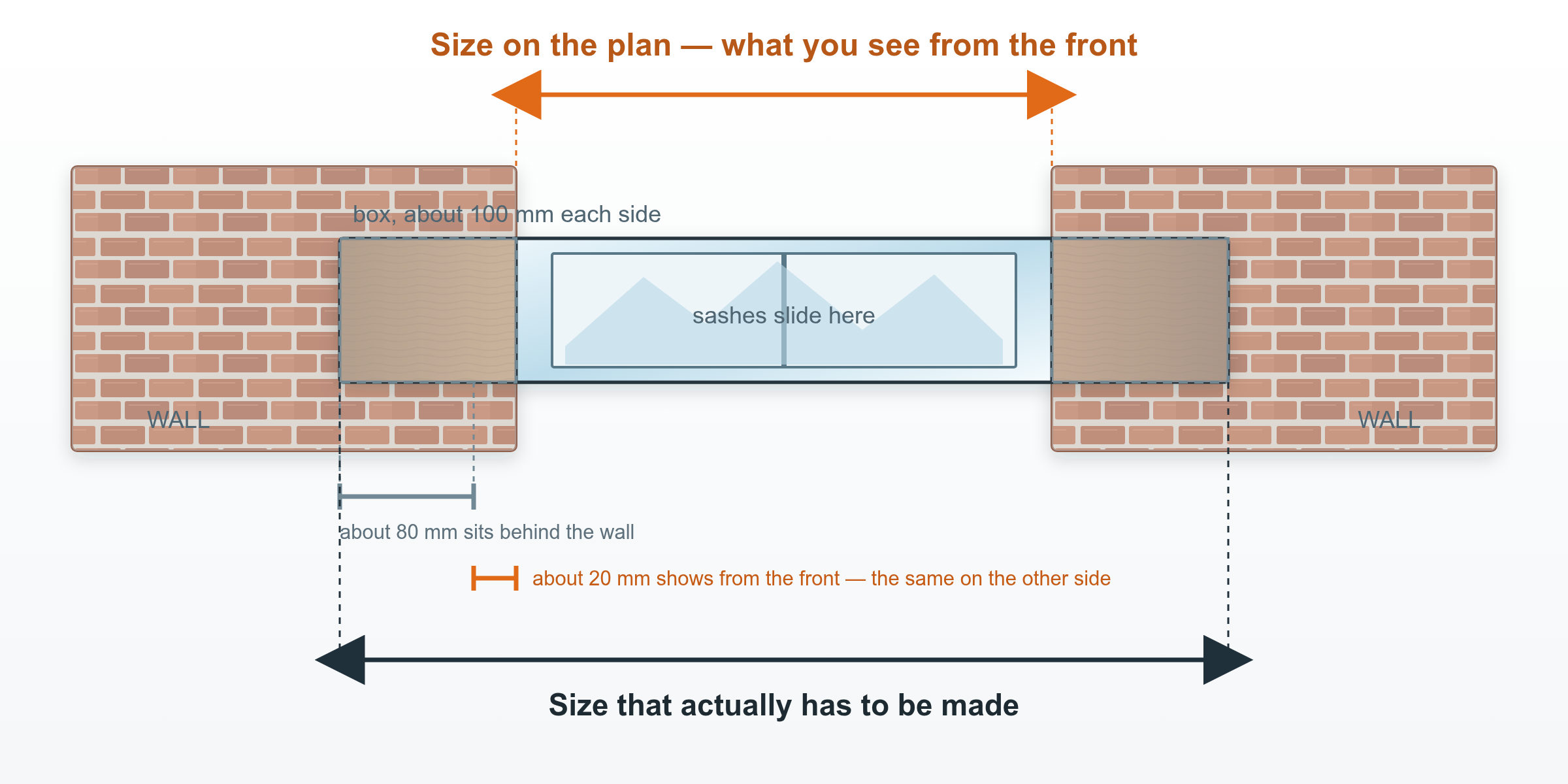
Figure C. A timber sash seen from above. The plan shows the width you can see from the front. The window that has to be made is wider, because the box at each side runs into the wall. Drawing not to scale.
Figures that measure different things
When you ask several suppliers for performance figures, the answers may not match. One supplier may give a whole-window U-value (Uw), which covers the frame and glass together. Another may give Ug, which covers the centre of the glass only.
A third may give a Window Energy Rating, which is a letter grade rather than a number. Ask all of them for the same measure, ideally the Uw. There is more on what the U-value and g-value on a quote mean.
As a baseline, the standard for a replacement window in England is a whole-window U-value of 1.4 W/m²K or lower, or a Window Energy Rating of Band B or better. That is set out in Approved Document L for dwellings in England, in the 2021 edition incorporating 2023 amendments, which currently applies. These figures apply in England.
A 2026 edition of Approved Document L has been published. It takes effect on 24 March 2027 for work that is not higher-risk building work (and later for higher-risk building work). Publication is not the same as being in force. Do not use the 2026 edition as the rule for a quote dated before that date.
Millimetres are the last trap. One quote gives the thickness of the sealed glass unit, meaning the panes and the gap between them. Another gives the depth of the frame. Both are in millimetres, and they measure different things.
When is the cheaper window quote the right one?
The cheaper quote is the right one when the product, the sizes, the glass and the site work match line for line, and nothing important is hidden in the small print. Then the lower price is simply lower, and you don’t need to pay more.
When a customer shows me two quotes, the gap usually comes from one of four places:
- Site work. The cheaper price covers fitting only, without finishing inside and out, or without taking the old windows away.
- Glass. It is thinner than a pane that size calls for, sometimes because the quote was priced on a smaller size.
- Product. It is a lower technical grade, which shows up as a worse U-value once you ask for one.
If your table shows none of those, the cheaper quote is the better price. What is left is checking the company behind it. A dearer quote only earns the difference if you can point to the row where it gives you more.
Checklist: before you compare the totals
Every quote names the product or range, not just the material.
The sizes match from quote to quote, and you know whether each came from a survey or a plan.
Every quote gives the glass make-up.
You know where the safety glass and trickle vents are.
Any performance figure you asked for is the same measure from every supplier. Removal and disposal are marked in or out for each window.
Each quote says what making good it includes, inside and out, and how. The quotes cover access, parking and building regulations compliance. You have asked what could change after survey.
Every question mark in your table has a written answer.
If you are comparing options for your property, send the basic requirements and PCW can explain the practical trade-offs before you decide.
Where these rules come from
The energy standard (whole-window U-value 1.4 W/m²K, or Window Energy Rating Band B): Approved Document L, Conservation of fuel and power, Volume 1: Dwellings, 2021 edition incorporating 2023 amendments, for use in England. Section 4, paragraphs 4.7 to 4.10 and Table 4.2. The 2026 edition, published 24 March 2026, takes effect on 24 March 2027 for work that is not higher-risk building work. Do not treat that edition as the current rule.
Safety glass: Approved Document K, Protection from falling, collision and impact, 2013 edition, for use in England. Section 5, paragraph 5.1 and Diagram 5.1.
Trickle vents: Approved Document F, Ventilation, Volume 1: Dwellings, 2021 edition, for use in England. Paragraphs 3.14 and 3.15.
Who certifies the work: The Building Regulations 2010, Schedule 3, as amended, sets out work that a person registered with a competent person scheme may self-certify. Designated schemes for replacement windows and doors include FENSA and CERTASS. A company outside those schemes goes through building control.
Karol Szymkiewicz, Perfect Crystal Windows