



Do you need planning permission to replace your windows?
Usually not, if you live in a house in England and the new windows look similar to the old ones. That kind of replacement is “permitted development”: allowed without an application. Flats, listed buildings and areas where the council has removed that right are different. The work must always meet building regulations, the national standards for building work.
This guide shows which rules apply to your home, who applies for what, and where a window company fits in. It works whoever fits your windows, including us.
In short: what applies to your home
- Houses, with new windows that look similar: usually no planning application.
- Flats: ask the council before you order, and check your lease.
- Conservation areas: ask whether an Article 4 direction, a council order that removes the right, covers your street.
- Listed buildings: changes to their character need listed building consent.
- Every replacement: building regulations apply, and you get a certificate to keep.
Jump to the five things to check before you order
Do you need planning permission to replace windows on a house?
Usually not. In England, replacing the windows on a house is permitted development, as long as the new windows are similar in appearance to the outside of the house as it is now.
What counts as “similar” is the council’s call. Replacing like for like is the clear case. If you want to change the style, the colour or the material, ask the council’s planning team first.
There are three exceptions to know about:
- A new bay window counts as an extension, so it may need permission.
- An upstairs window in a side wall must have obscure glass, meaning glass you can’t see clearly through, at level 3 or higher on the usual 1-to-5 privacy scale. It must also be fixed shut, unless the part that opens is more than 1.7 metres above the floor. Councils differ on whether this applies when you simply replace an existing side window, so ask yours first.
- A condition on the planning permission your house was built under still applies, if it limits changes. Your council can tell you whether there is one.
So for most houses, there’s nothing to apply for. Don’t pay anyone to apply just in case. If you’d like it confirmed in writing, you can ask the council for a lawful development certificate, which confirms that the work you plan would be lawful.
The Planning Portal’s guide to windows and planning permission covers the same rules.
For most houses, there’s nothing to apply for. Don’t pay anyone to apply just in case.
What if you live in a flat?
Flats don’t have the permitted development rights that houses have. But that doesn’t mean every window swap in a flat needs permission.
Work that doesn’t materially change how a building looks isn’t classed as “development” at all. But councils apply that differently. Lambeth Council, for example, says a like-for-
like replacement in a flat doesn’t need planning permission, while a change in design, opening method, materials or frame profile normally does. Lewisham Council says flats
need planning permission to replace windows.
So ask your council’s planning team before you order, and get the answer in writing.
Check your lease, too. It may say who owns the windows, and whether you need the freeholder’s agreement before you change them. The freeholder is whoever owns the building itself. If you’re not sure, ask your managing agent or the freeholder.
What changes in a conservation area or a listed building?
A house in a conservation area keeps its right to replace windows without applying, unless the council has removed that right with an Article 4 direction. A listed building is different: any change that affects its character needs listed building consent.
Conservation areas. A conservation area is an area the council has designated for its special architectural or historic interest. Being in one doesn’t by itself stop you replacing a house’s windows.
But the council can make an Article 4 direction, an order that removes some permitted development rights in a particular area. Ask the council whether one covers your street. In London, that’s usually your borough council. You can find your local council on GOV.UK.
Listed buildings. A listed building is protected for its special architectural or historic interest. Any alteration that would affect that character needs listed building consent, and that covers work inside as well as outside. Whether your change affects the
character is the council’s judgement, so even a like-for-like swap isn’t automatic.
In both cases, speak to the council’s planning or conservation team before you order anything, not after.
In a listed building, ask the council before you order anything, not after.
Who applies for permission: you or your window company?
You apply for planning permission or listed building consent yourself, or hand it to an architect or planning agent. A window company can prepare the technical documents for your application.
Those can include technical drawings of the new windows, certificates for the products, and reports on how the glass and frames perform, such as how much heat they let through. Before you commit, ask any window company whether it can supply them.
The building regulations certificate works differently. If your installer is registered with a government-authorised scheme, it arranges that certificate after the windows are fitted. The next section explains how.
What PCW does on listed and conservation-area homes
Perfect Crystal Windows regularly works on listed buildings and homes in conservation areas, fitting timber windows.
Our own joinery makes timber windows to match the original details:
- glazing bars, the thin bars that divide the glass into panes
- mouldings, the shaped profiles cut into the timber
- horns, the short shaped extensions at the bottom of an upper sash’s sides
- sash proportions, the size and balance of each opening part
We can prepare the technical documents for your application: technical drawings, product certificates, and technical performance reports for the glass and products.
What we don’t do: we can’t promise what a council will decide, and we don’t form or widen openings. A new or wider opening is builder’s work.
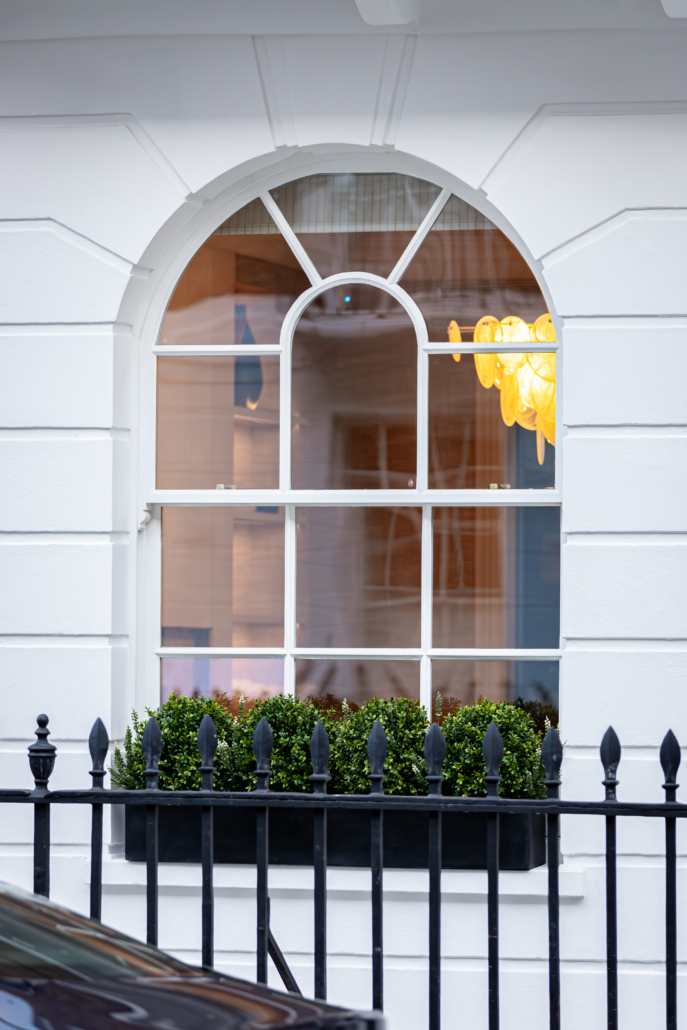
FIGURE A. TIMBER WINDOWS FROM PCW’S OWN JOINERY: AN ARCHED HEAD, SLIM GLAZING BARS AND SASH PROPORTIONS MATCHED TO THE HOUSE.
What do building regulations mean for replacement windows?
Replacement windows always have to meet building regulations, even when no planning permission is needed. In England, either an installer registered with a government-authorised scheme certifies the work, or a building control body, an independent checker, approves it. Either way, you get a certificate. Keep it.
The common mistake: treating two questions as one
Planning permission is mostly about how your home looks. Most houses don’t need it for like-for-like windows.
Building regulations are about how the new windows perform. Every replacement has to meet them.
“No planning permission needed” doesn’t mean “no rules”.
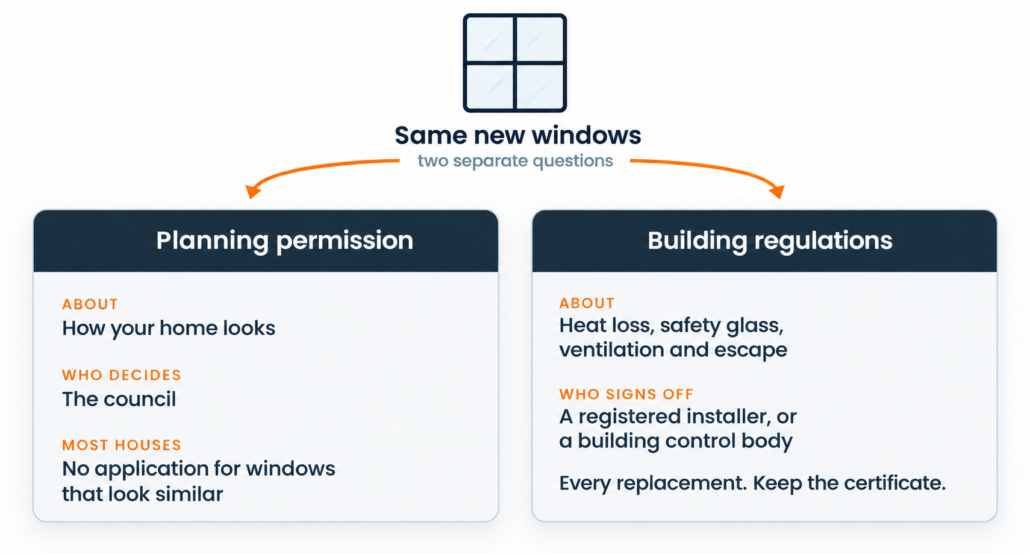
FIGURE B. PLANNING PERMISSION AND BUILDING REGULATIONS: TWO SEPARATE QUESTIONS FOR THE SAME WINDOWS.
Building regulations cover four things when you replace windows:
- Heat loss. The new windows must meet a standard for how much heat escapes through them.
- Safety glass. Glass less than 800 mm above the floor, and glass in or beside doors, usually needs to be safety glass, made to break safely or resist breaking.
- Ventilation. If your old windows have background ventilators, small vents often called trickle vents, the new ones should have them too, and no smaller. If they don’t, the new windows may still need them, unless the room is ventilated another way.
- Escape. In a house, if a window is one you could escape through in a fire, the replacement should still be big enough to escape through.
A registered installer should check all four for you. You can check an installer’s registration on its scheme’s own website. Our guide on how to check a window company before you buy shows you how.
A written quote should say who will certify the work. Our guide on how to compare window quotes properly shows what else each quote should include.
Five things to check before you order
Work down the list in this order. An answer near the top can change the ones below it.
- Is your home listed? If it is, speak to the council before anything else.
- Is it a house or a flat?
- Has the council removed your rights, through an Article 4 direction or a condition on your home’s original planning permission?
- Will the new windows look similar to what’s there now?
- Who will certify the work under building regulations, and will you get the certificate?
Perfect Crystal Windows has been manufacturing and installing for 25 years. Whatever kind of home you have, send PCW the basic requirements and we’ll explain the practical trade-offs before you decide.
Where these rules come from
All of these apply in England.
Permitted development for houses: Town and Country Planning (General Permitted Development) (England) Order 2015, articles 2(1), 3(4) and 4, and Schedule 2, Part 1, Class A, paragraphs A.2 and A.3 (in force; version checked 27 September 2026).
What counts as development, lawful development certificates and London councils: Town and Country Planning Act 1990, sections 1(2), 55(2)(a) and 192.
How the householder rules are applied: GOV.UK, Permitted development rights for householders: technical guidance (updated September 2019).
Flats (council examples): Lambeth Council, Replacing windows in a flat. Lewisham Council, Do you need planning permission to replace windows? (published 21 October 2022).
Listed buildings and conservation areas: Planning (Listed Buildings and Conservation Areas) Act 1990, sections 7 and 69.
Signing off replacement windows: The Building Regulations 2010, Schedule 3, as amended. GOV.UK, Competent person scheme: current schemes and how schemes are authorised (updated 17 September 2026).
Heat loss: Approved Document L, Volume 1, 2021 edition incorporating 2023 amendments, in force since 15 June 2022. A 2026 edition was published on 24 March 2026 and takes effect on 24 March 2027.
Safety glass: Approved Document K, 2013 edition, Section 5.
Ventilation: Approved Document F, Volume 1, 2021 edition, in force since 15 June 2022, paragraphs 3.14 and 3.15.
Escape: Approved Document B, Volume 1, 2019 edition incorporating 2020, 2022, 2025 and 2026 amendments, paragraph 2.19.
Consumer guidance: Planning Portal, Doors and windows: planning permission and Doors and windows: Building Regulations.
Karol Szymkiewicz, Perfect Crystal Windows